Rabu, 19 Juni 2013

2013 April 13: Sun with Solar Flare

See Explanation.  Clicking on the picture will download
 the highest resolution version available.


Image Credit: NASA Solar Dynamics Observatory
 
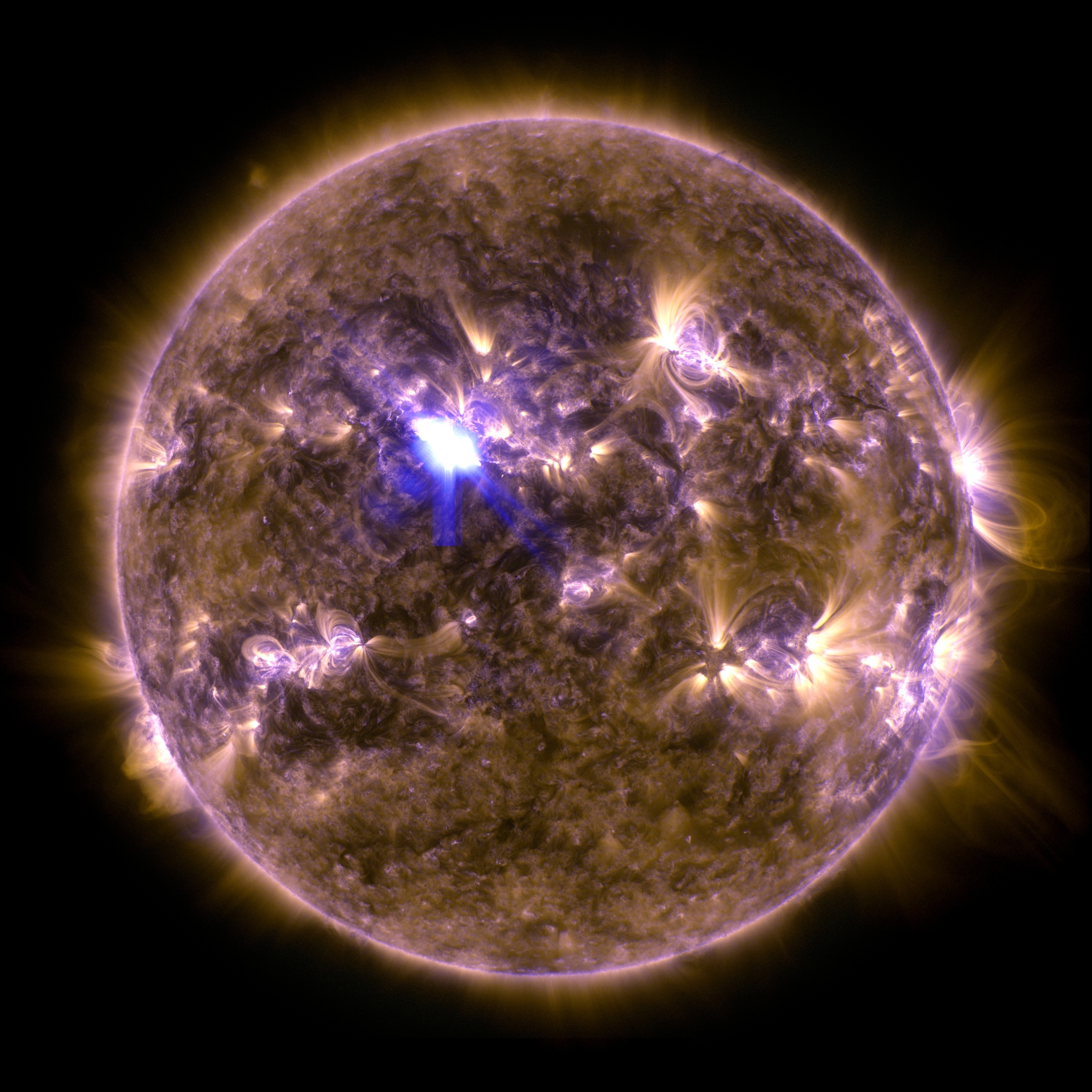
Explanation: This week the Sun gave up its strongest solar flare so far in 2013, accompanied by a coronal mass ejection (CME) headed toward planet Earth. A false-color composite image in extreme ultraviolet light from the Solar Dynamics Observatory captures the moment, recorded on April 11 at 0711 UTC. The flash, a moderate, M6.5 class flare erupting from active region AR 11719, is near the center of the solar disk. Other active regions, areas of intense magnetic fields seen as sunspot groups in visible light, mottle the surface as the solar maximum approaches. Loops and arcs of glowing plasma trace the active regions' magnetic field lines. A massive cloud of energetic, charged particles, the CME will impact the Earth's magnetosphere by this weekend and skywatchers should be on the alert for auroral displays.

2013 April 12: Yuri's Planet

See Explanation.  Clicking on the picture will download
 the highest resolution version available.


Image Credit: ISS Expedition 30, NASA
 
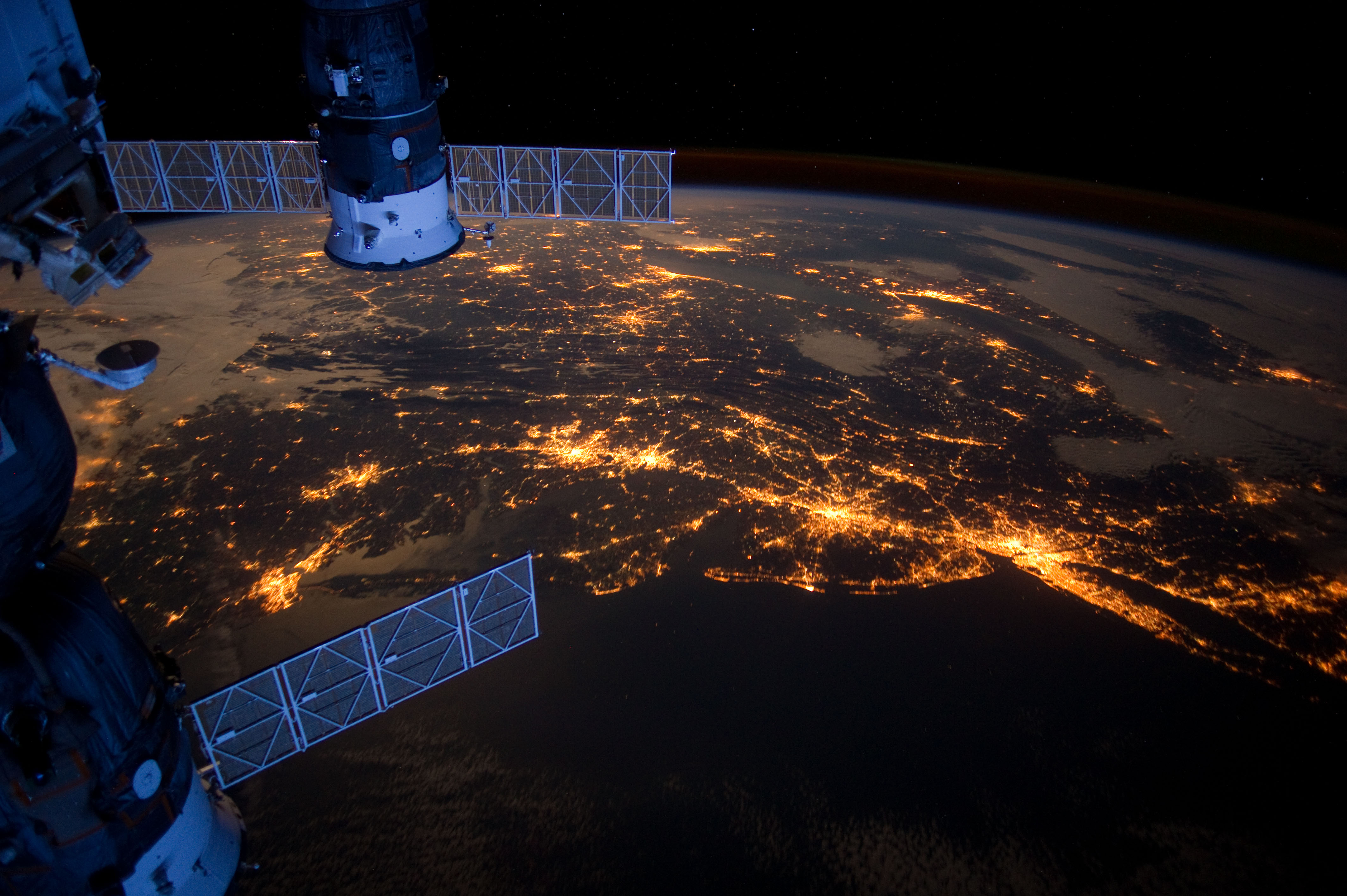
Explanation: On another April 12th, in 1961, Soviet cosmonaut Yuri Alexseyevich Gagarin became the first human to see planet Earth from space. Commenting on his view from orbit he reported, "The sky is very dark; the Earth is bluish. Everything is seen very clearly". On yet another April 12th, in 1981 NASA launched the first space shuttle. To celebrate in 2013, consider this image from the orbiting International Space Station, a stunning view of the planet at night from low Earth orbit. Constellations of lights connecting the densely populated cities along the Atlantic east coast of the United States are framed by two Russian spacecraft docked at the space station. Easy to recognize cities include New York City and Long Island at the right. From there, track toward the left for Philadelphia, Baltimore, and then Washington DC near picture center.

2013 April 11: Darkened City

See Explanation.  Clicking on the picture will download
 the highest resolution version available.


Image Credit & Copyright: Photo Thierry Cohen / Courtesy Danziger Gallery, New York 
 
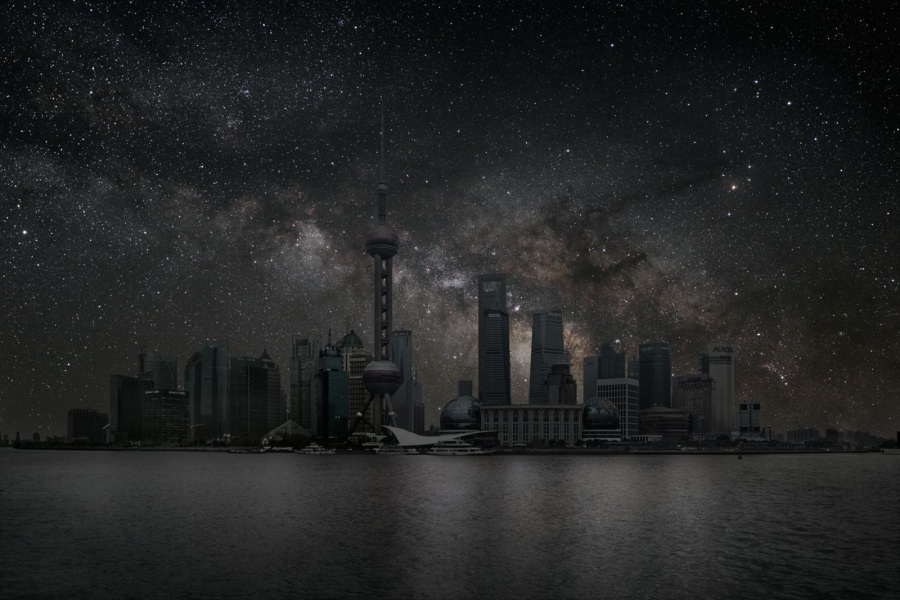
Explanation: In a haunting vista you can never see, bright stars and the central Milky Way rise over the dark skyline of metropolitan Pudong in Shanghai, China. Looking east across the Huangpu River, the cityscape includes Pudong's 470 meter tall Oriental Pearl Tower. The night sky stretches from Antares and the stars of Scorpius at the far right, to Altair in Aquila at the left. To create the vision of an unseen reality, part of a series of Darkened Cities, photographer Thierry Cohen has combined a daytime image of the city skyline with an image matched in orientation from a dark sky region at the same latitude, just west of Merzouga, Morocco. The result finds the night sky that hours earlier also arced over Shanghai, but drowned in the lights of a city upon the sea.

2013 April 10: Space Station Lookout

See Explanation.
Moving the cursor over the image will bring up an annotated version.
Clicking on the image will bring up the highest resolution version
available.


Image Credit & Copyright: Chris Hadfield (CSA); Annotation assistance: Vincent Berseth
 
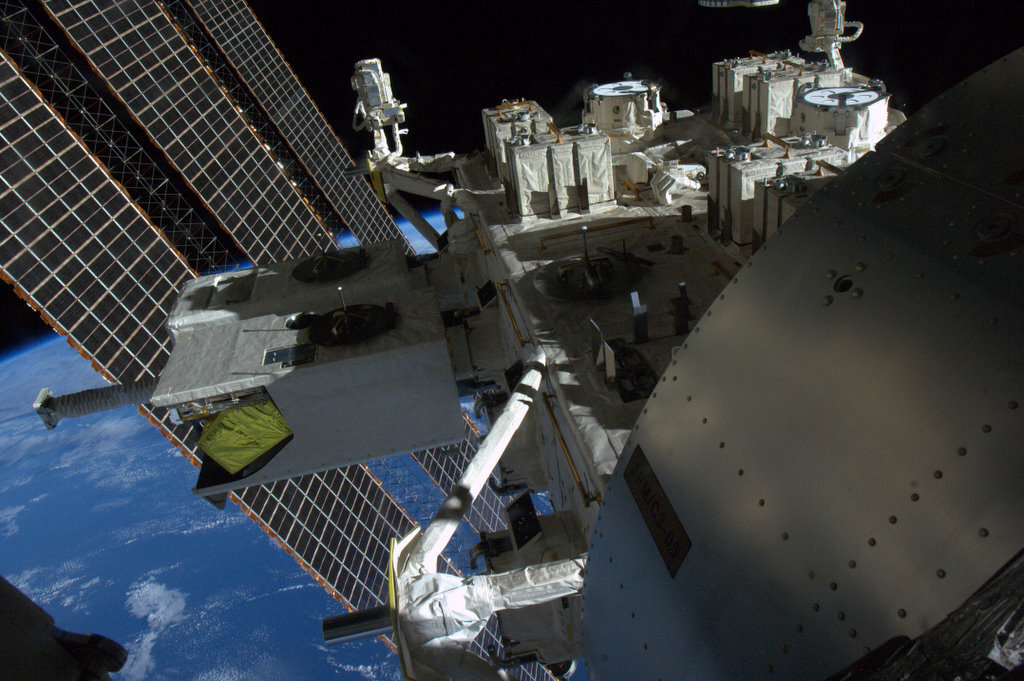
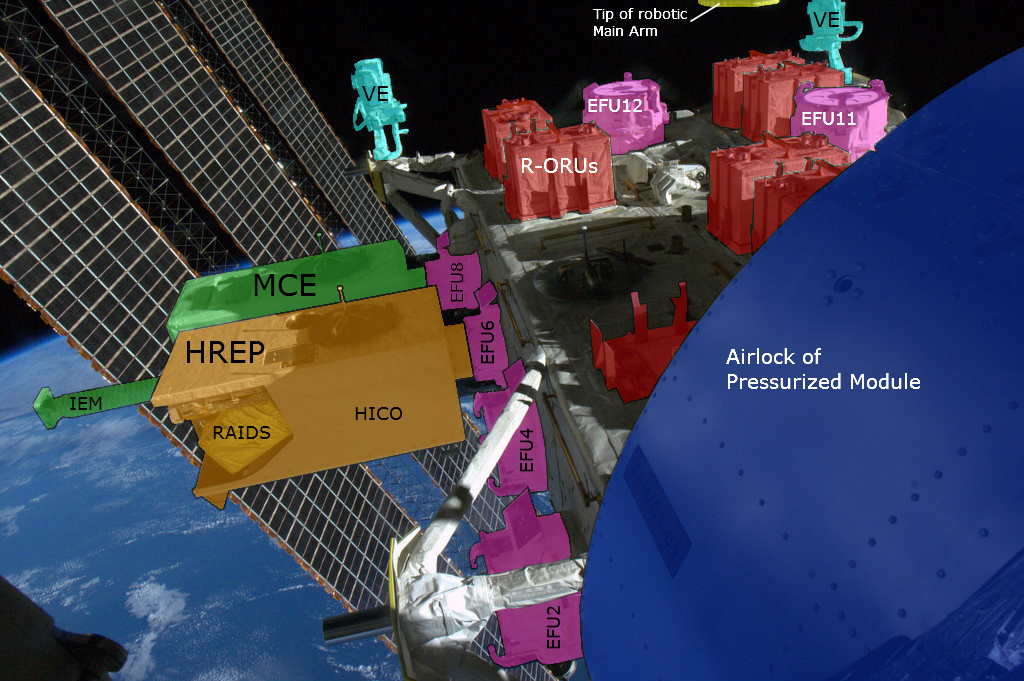
Explanation: If you glanced out a side window of the International Space Station, what might you see? If you were Expedition 34 flight engineer Chris Hadfield, and you were looking out one of windows of Japan's Kibo Research Module on February 26, you might have seen the above vista. In the distance lies the darkness of outer space and the blueness of planet Earth. Large ISS objects include long solar panels that stretch diagonally from the upper left and the cylindrical airlock of the Pressurized Module that occupies the lower right. Numerous ports and platforms of the space station are visible and labeled on an annotated companion image. Of particular note is what looks to be a washer - dryer pair toward the image left, which are really NASA's HREP (near) and JAXA's MCE (far) research platforms. The gold foil covered experiment in the rear of HREP is the Remote Atmospheric and Ionospheric Detection System (RAIDS) that monitors atmospheric airglow, while MCE includes the Global Lightning and Sprite Measurements (JEM-GLIMS) instrument that monitors atmospheric electrical discharges. The current Expedition 35 crew is now commanded by Colonel Hadfield and scheduled to stay aboard the space station until May.

2013 April 9: NGC 3132: The Southern Ring Nebula

See Explanation.  Clicking on the picture will download
 the highest resolution version available.


Image Credit: Hubble Legacy Archive, ESA, NASA; Processing - Donald Waid
 
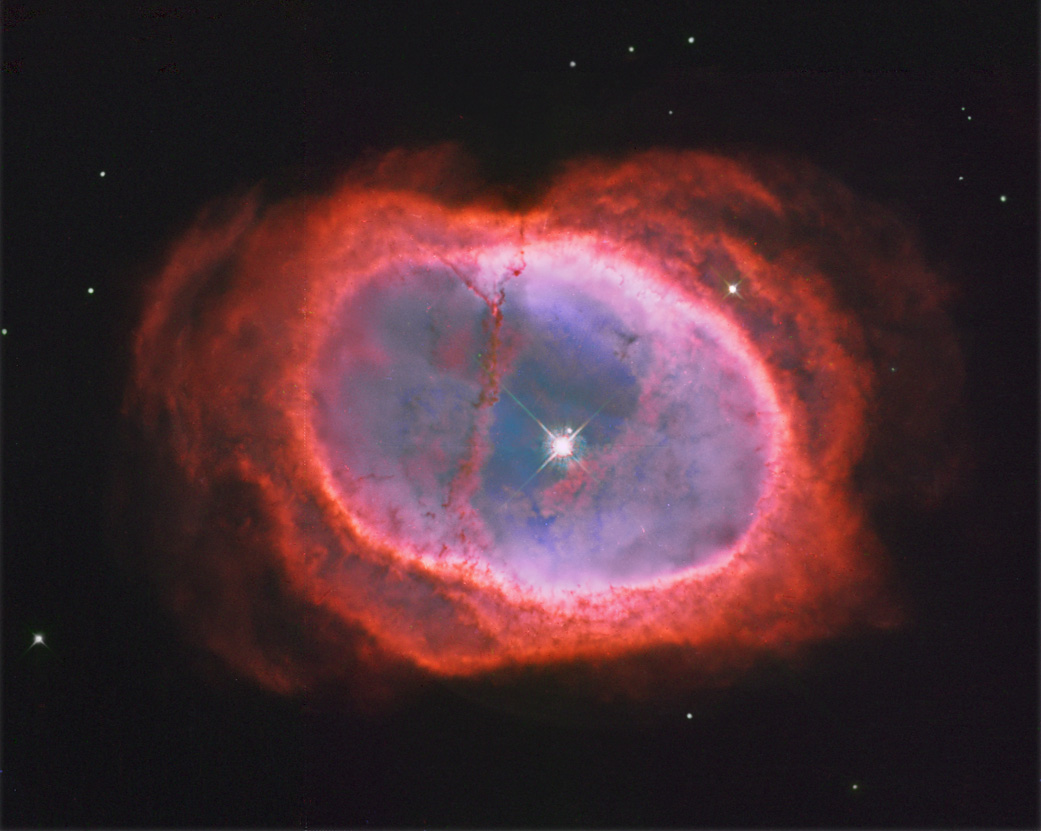
Explanation: It's the dim star, not the bright one, near the center of NGC 3132 that created this odd but beautiful planetary nebula. Nicknamed the Eight-Burst Nebula and the Southern Ring Nebula, the glowing gas originated in the outer layers of a star like our Sun. In this reprocessed color picture, the hot purplish pool of light seen surrounding this binary system is energized by the hot surface of the faint star. Although photographed to explore unusual symmetries, it's the asymmetries that help make this planetary nebula so intriguing. Neither the unusual shape of the surrounding cooler shell nor the structure and placements of the cool filamentary dust lanes running across NGC 3132 are well understood.

2013 April 8: A Redshift Lookup Table for our Universe

See Explanation.  Clicking on the picture will download
 the highest resolution version available.


Image Credit: Sergey V. Pilipenko (LPI, MIPT)
 
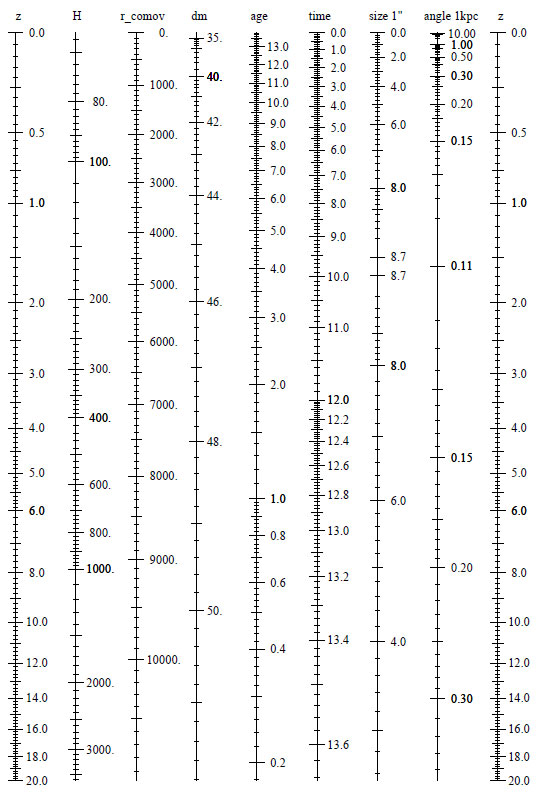
Explanation: How far away is "redshift six"? Although humans are inherently familiar with distance and time, what is actually measured for astronomical objects is redshift, a color displacement that depends on exactly how energy density has evolved in our universe. Now since cosmological measurements in recent years have led to a concordance on what energy forms pervade our universe, it is now possible to make a simple table relating observed cosmological redshift, labeled "z", with standard concepts of distance and time, including the extrapolated time since the universe began. One such table is listed above, where redshift z is listed in the first and last columns, while the corresponding universe age in billions of years is listed in the central column. To find the meaning of the rest of the columns, please read the accompanying technical paper. Although stars in our galaxy are effectively at cosmological redshift zero, the most distant supernovae seen occur out past redshift one, which the above chart shows occurred when the universe was approximately half its present age. By contrast, the most distant gamma-ray bursts yet observed occur out past redshift six, occurring when the universe was younger than one billion years old, less than 10 percent of its present age.
2013 April 7: The Moon's Saturn

See Explanation.  Clicking on the picture will download
 the highest resolution version available.


Image Credit & Copyright: Jens Hackmann
 
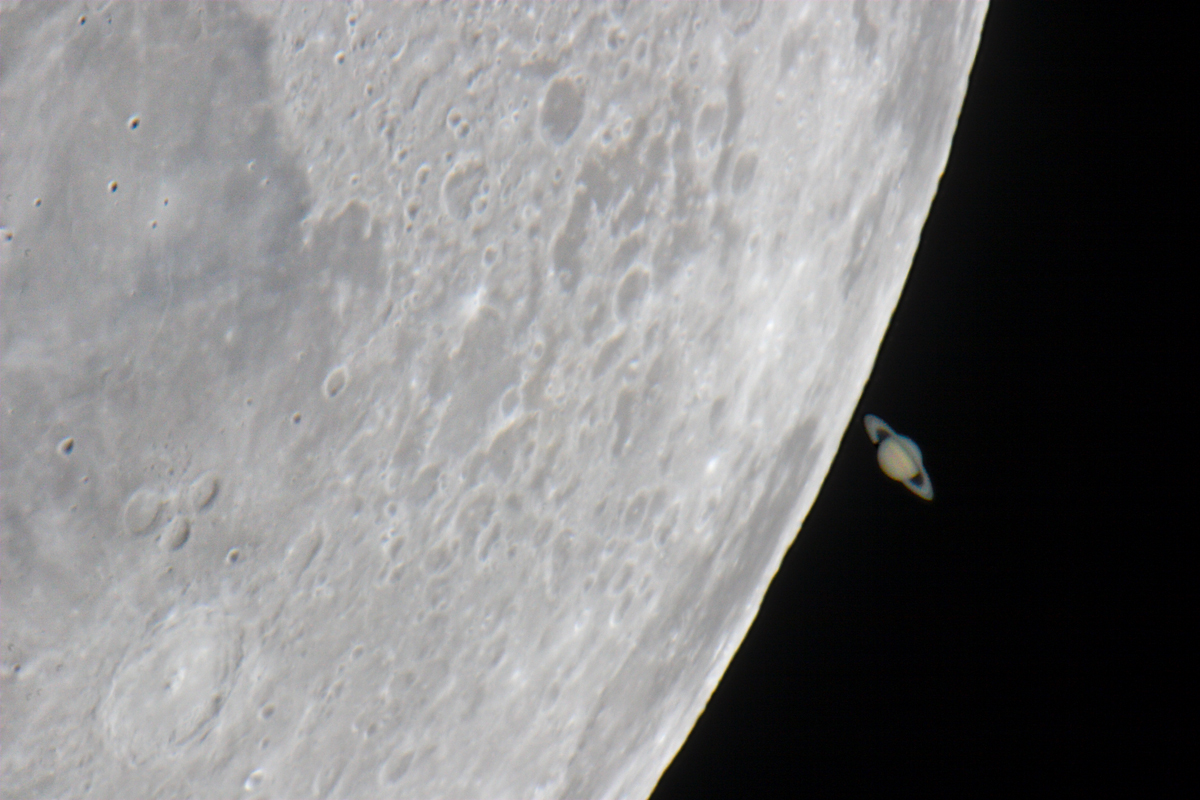
Explanation: Just days after sharing the western evening sky with Venus in 2007, the Moon moved on to Saturn - actually passing in front of the ringed planet Saturn when viewed in skies over Europe, northern Africa, and western Asia. Because the Moon and bright planets wander through the sky near the ecliptic plane, such occultation events are not uncommon, but they are dramatic, especially in telescopic views. For example, in this sharp image Saturn is captured emerging from behind the Moon, giving the illusion that it lies just beyond the Moon's bright edge. Of course, the Moon is a mere 400 thousand kilometers away, compared to Saturn's distance of 1.4 billion kilometers. Taken with a digital camera and 20 inch diameter telescope at the Weikersheim Observatory in southern Germany, the picture is a single exposure adjusted to reduce the difference in brightness between Saturn and the cratered lunar surface.