
Credit & Copyright: T. Rector (U. Alaska Anchorage), & N.S. van der Bliek (NOAO/AURA/NSF)
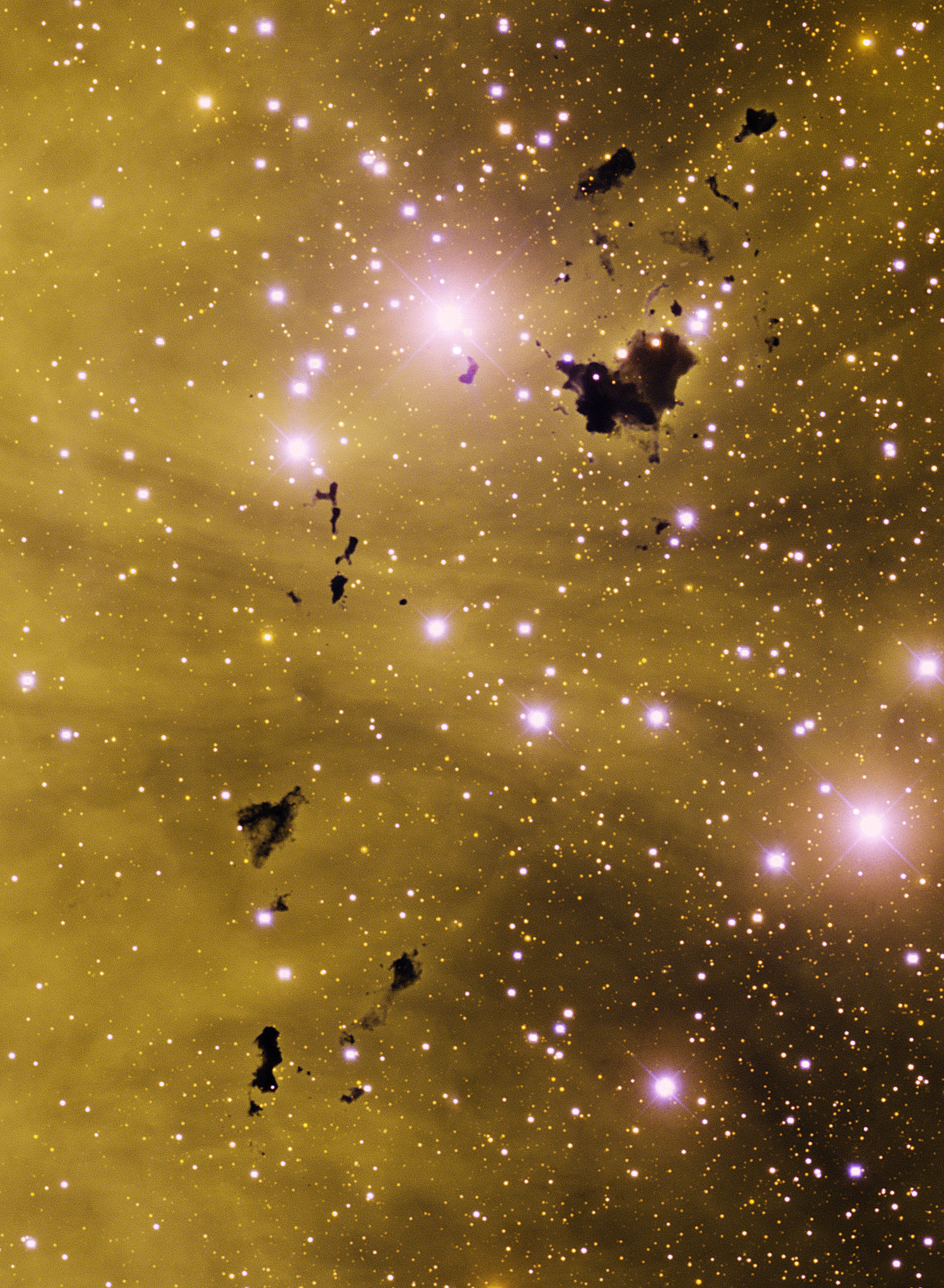
Explanation: These are larger dust
bunnies than you will find under your bed. Situated in
rich star fields and glowing hydrogen gas, these opaque clouds of
interstellar dust and gas are so large they might be able to form stars. Their home is known as
IC 2944, a bright stellar nursery located about 5,900 light years away toward the constellation of
Centaurus. The largest of these
dark globules, first spotted by South African astronomer
A. D. Thackeray in 1950, is likely two separate but overlapping clouds, each more than one
light-year wide. Along with other data, the
above representative color image from the
4-m Blanco telescope at
Cerro Tololo,
Chile indicates that Thackeray's globules are fractured and churning as a result of intense ultraviolet radiation from young, hot stars already energizing and heating the bright
emission nebula. These and similar
dark globulesknown to be associated with other star forming regions may ultimately be dissipated by their hostile environment -- like
cosmic lumps of
butter in a hot frying pan.

Tidak ada komentar:
Posting Komentar