
Image Credit & Copyright: Michael Joner, David Laney (West Mountain Observatory, BYU); Processing - Robert Gendler
Explanation: Framing a bright emission region
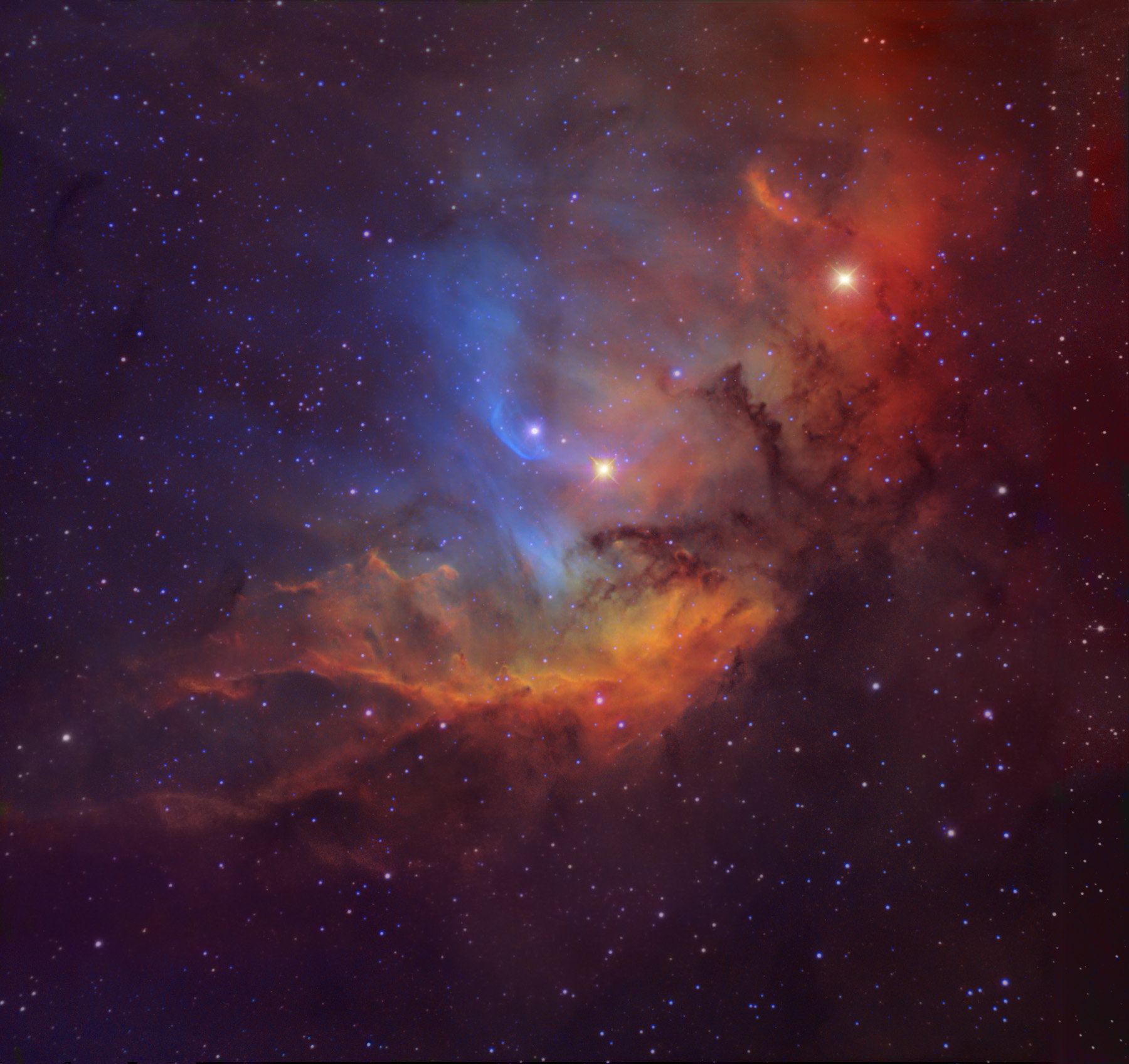
this telescopic view looks out along the plane of our Milky Way Galaxy toward the nebula rich constellation
Cygnus the Swan. Popularly called the Tulip Nebula the glowing cloud of interstellar gas and dust is also found in the
1959 catalog by astronomer Stewart Sharpless
as Sh2-101. About 8,000 light-years distant the nebula is understandably not the only
cosmic cloud to evoke the imagery
of flowers. The complex and beautiful nebula is shown here in a composite image that
maps emission from ionized sulfur, hydrogen, and oxygen atoms into red, green, and blue colors. Ultraviolet radiation from young, energetic
O star HDE 227018
ionizes the atoms and powers the emission from the Tulip Nebula. HDE 227018 is the bright star very near the blue arc at image center.

Tidak ada komentar:
Posting Komentar